
A Bhutanese Firm, Serving the World
From Bhutan to the World
Eco Policy Nexus International was established to create a modern Bhutanese advisory firm capable of delivering high-quality consulting, research and development solutions that respond to both local priorities and global challenges.
Better evidence leads to better decisions. Better decisions create better outcomes for people, economies and the planet.

To become a trusted Bhutanese knowledge and advisory firm with regional relevance and global reach, connecting local insight with international expertise to support sustainable development and inclusive economic growth.
To help governments, organizations, businesses and development partners transform evidence into action, policies into impact and opportunities into sustainable results.
Why Eco Policy Nexus International
Five reasons the firm exists as a Bhutanese advisory practice with work that can travel.
- 01Bhutanese Insight
Deeply rooted in Bhutan's development experience, institutions, communities and values.
- 02Analytical Excellence
Transforming data, research and evidence into actionable strategies and informed decision-making.
- 03Integrated Solutions
Bringing together economic, environmental and social perspectives to address interconnected development challenges.
- 04Implementation Focus
Moving beyond analysis to support execution, delivery and measurable impact.
- 05Global Perspective
Drawing on international knowledge and partnerships while remaining grounded in local realities.
Our role
The firm sits between analysis and the institution that must act. Each pairing is a piece of work, not a slogan.
- EvidencePolicy that can be explained
- StrategyImplementation with owners and dates
- GrowthEnvironmental and social limits
- CommunitiesInstitutions that decide
- Bhutanese experienceInternational knowledge
Who we work with
- GovernmentsMinistries and public agencies that need evidence they can defend in a cabinet, a budget, or a reform.
- Public institutionsRegulators, statistical offices, and public enterprises building systems that outlast a single project.
- Development partnersOrganizations that want Bhutanese insight joined to international standards of analysis and delivery.
- BusinessesFirms weighing investment, climate risk, inclusion, or a partnership that has to work on the ground.
- CommunitiesPeople affected by a policy or project, included so livelihoods and local knowledge are part of the evidence.
Our approach
Assignments follow the same spine, whether the subject is a budget choice, a climate risk, or a partnership.
- 1
Local understanding
Start from Bhutanese institutions, communities, and the decision a client actually has to make. Context comes before a template.
- 2
Analytical rigor
Use data, research, and clear assumptions. Say what the evidence supports and where it is thin.
- 3
Strategic thinking
Connect economic, environmental, and social choices so a recommendation does not solve one problem by creating another.
- 4
Practical implementation
Carry the work past a report: design, roles, timelines, and a way to see whether the result is happening.
- 5
Global perspective
Bring international practice in when it fits, and keep the advice accountable to local realities.
Our story
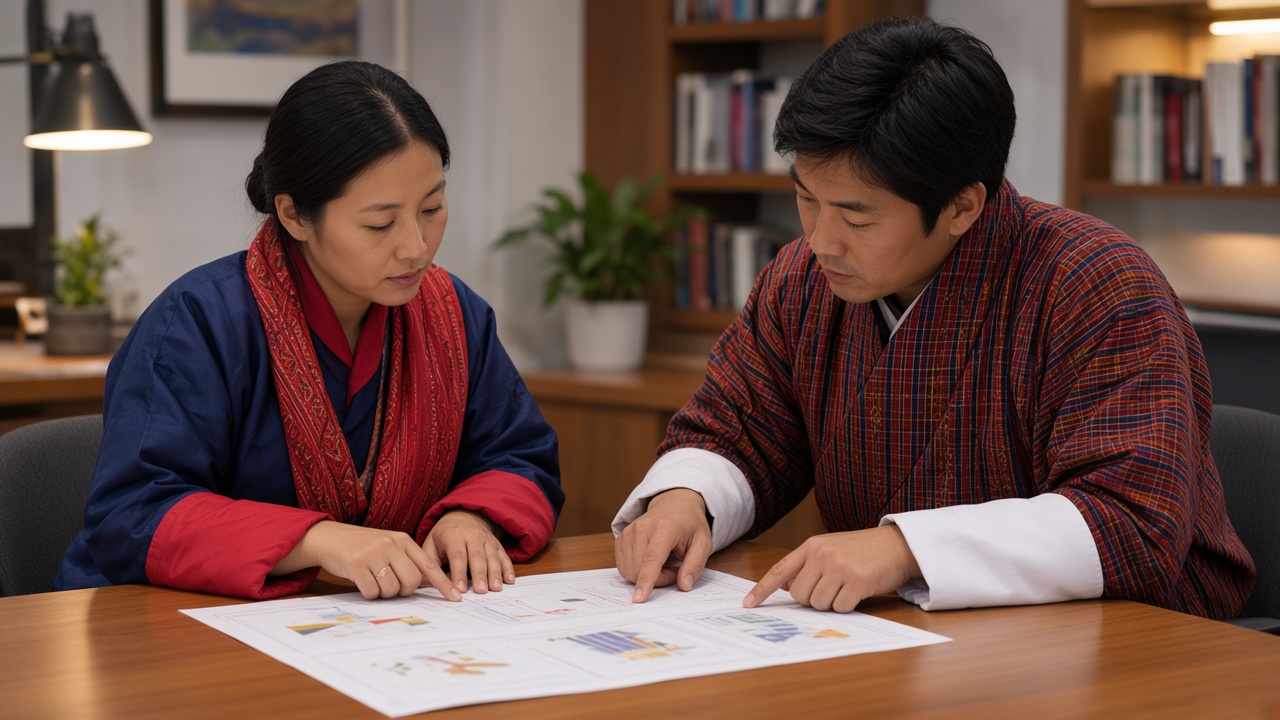
Bhutan's development experience shows that economic progress can be pursued alongside environmental responsibility, cultural preservation, social wellbeing and effective governance. We draw on that foundation while using modern analytical tools and international knowledge.
Gross National Happiness is the reference point for that experience: prosperity considered together with the environment, culture, wellbeing, and governance. The firm uses that foundation with contemporary economics, data, and project delivery. It does not claim to speak for the Royal Government of Bhutan.
Global engagement
The office is in Thimphu. Collaboration outside Bhutan is scoped to the assignment. The film shows that reach. It is not a list of branch offices.
Asia
Home region. Work is based in Thimphu and arranged with partners across Asia when a mandate needs it.
Africa
Shared questions on growth, climate, and inclusion, taken up through knowledge exchange rather than a local office.
Europe
Research, finance, and institutional partners where a Bhutanese brief needs an outside counterpart.
Pacific
Island and mountain contexts where resilience and small-economy policy travel in both directions.
Americas
Collaboration scoped to the assignment: methods, investment, or joint learning.
Looking forward
Over the coming years we aim to expand capabilities in artificial intelligence and advanced analytics, development economics, climate finance, sustainable investment, digital transformation, geospatial intelligence, impact measurement, inclusive economic development, public-private partnerships, and global knowledge exchange.
- Artificial intelligence and advanced analytics
- Development economics
- Climate finance
- Sustainable investment
- Digital transformation
- Geospatial intelligence
- Impact measurement
- Inclusive economic development
- Public-private partnerships
- Global knowledge exchange
Rooted in Bhutan. Engaged with the World. Evidence. Solutions. Partnerships. Impact.
Talk to the firm